
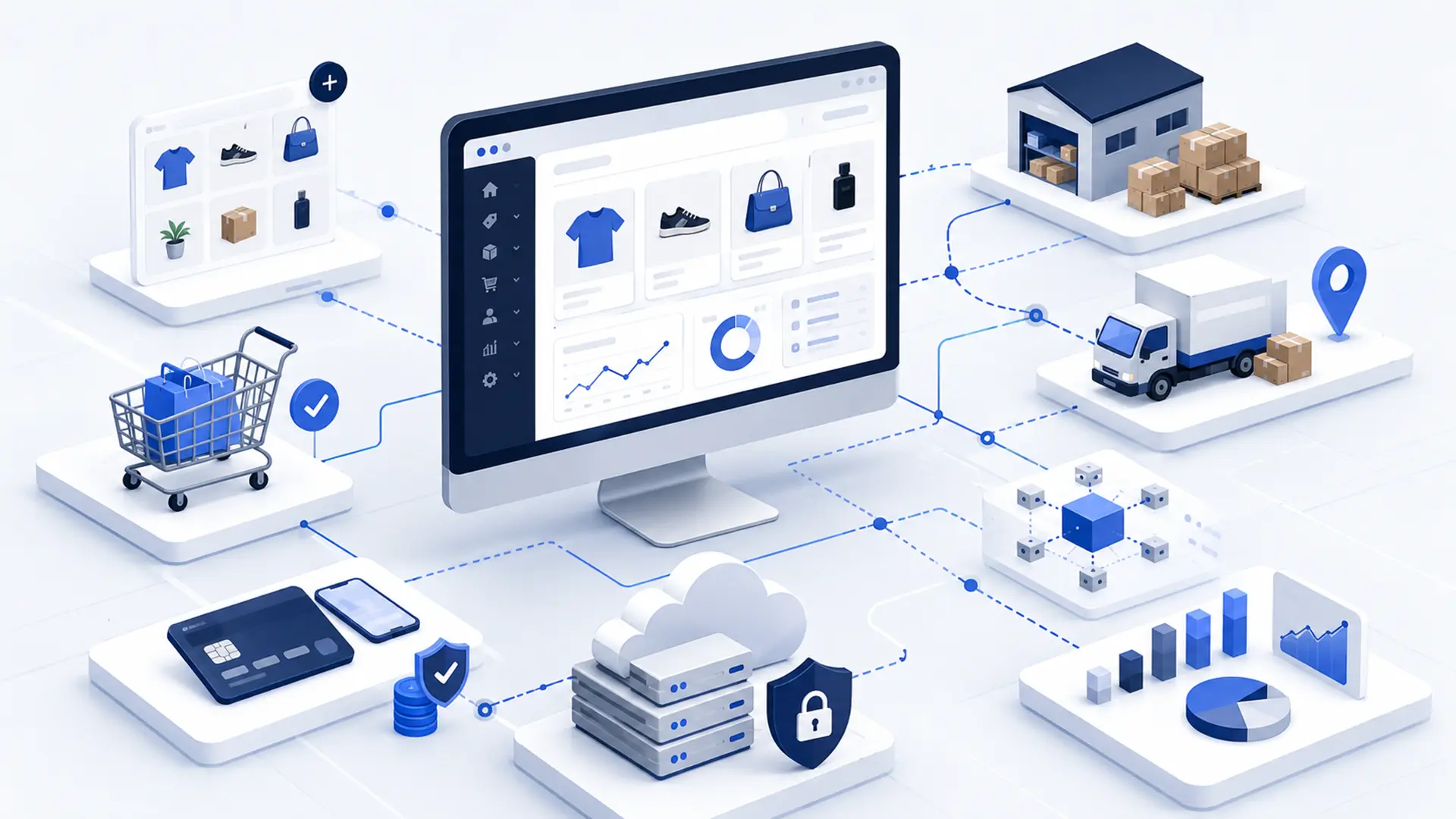
Choosing an e-commerce platform determines far more than the store design. It directly affects how products are managed, orders are processed, payment and shipping systems are connected, campaigns are created and how easily the business can evolve as it grows.
That is why it is not enough to compare superficial criteria such as the number of ready-made themes, the monthly package price or how many products can be added. A small boutique store and a business managing thousands of products, multiple warehouses, marketplaces and ERP integrations do not have the same needs.
The right approach is to define the commercial and operational requirements first, then evaluate how naturally and sustainably the platform can meet them without introducing unnecessary complexity.
Define Your E-Commerce Business Model First
Before comparing platforms, define how the store will actually operate. Technical requirements follow directly from the business model. A single-product brand, a subscription business and a store managing many categories and warehouses will not need the same platform.
- How many products and variations will be managed?
- Will you sell physical products, digital products or services?
- Will the business use a B2C, B2B or hybrid sales model?
- Will there be one warehouse or multiple inventory locations?
- Will the store also sell through marketplaces?
- Are subscriptions, dealer pricing, quotations or custom pricing required?
- Are international sales planned?
- How will returns, exchanges and after-sales support work?
Comparing feature lists before answering these questions can lead to a system that is either excessive or insufficient for the business.
What Should You Consider When Choosing an E-Commerce Platform?
A good e-commerce platform should cover the core functions the business needs today while remaining reasonably adaptable to new processes tomorrow. That is why the decision should never be based on a single criterion.
| Criterion | Why It Matters |
|---|---|
| Product and variation management | Shows whether the catalog structure matches the actual sales model. |
| Order and inventory management | Affects how efficiently daily operations can be handled. |
| Payment infrastructure | Determines the flexibility of collections, installments and payment options. |
| Shipping integration | Can automate shipment creation and tracking workflows. |
| API and integration | Enables connections with ERP, accounting, CRM and marketplace systems. |
| Performance | Affects system stability as traffic and transaction volume increase. |
| SEO control | Determines how much control you have over URLs, metadata, canonicals and content architecture. |
| Security and backups | Reduces the risk of data loss and operational downtime. |
| Ease of administration | Directly affects the team’s daily workload. |
| Scalability | Shows how far the platform can evolve as the store grows. |
At Webrote, we approach e-commerce systems not merely as storefront interfaces, but as connected environments where products, payments, orders, shipping, integrations and technical operations work together.
Hosted E-Commerce Platform or Custom System?
Hosted e-commerce platforms can offer advantages such as faster setup, standard features out of the box and more predictable initial costs. For businesses with standard requirements, this approach is often sufficient.
A custom system becomes relevant when product, pricing, order or integration workflows cannot be handled properly by standard solutions. But building every project from scratch is not always the right choice. It may be more practical to use the strengths of an established platform and develop only the modules specific to the business.
The decision should not be framed as “hosted is bad, custom is good.” The real question is which approach can provide the required control and flexibility with the lowest overall complexity.
For a more detailed comparison, you can also read our Off-the-Shelf Software vs. Custom Software guide.
How Do Products and Variations Affect Platform Choice?
The e-commerce platform should support your product model naturally. Simple products, color and size variations, bundles, customizable options and products with many technical attributes may require very different structures.
As the catalog grows, category, filter, attribute and variation structures become increasingly important. It is not enough for a platform to simply allow products to be added; bulk updates, import and export capabilities and rule-based filtering should also be evaluated.
- Can product variations be defined flexibly?
- Can products be updated in bulk?
- Will filters and attributes remain manageable as the catalog grows?
- Can price and stock be managed separately for each variation?
- Can product data be exported or sent to other systems?
- Can the category structure be controlled for SEO and user experience?
How Flexible Should Order and Inventory Management Be?
Once sales begin, order management becomes the center of e-commerce operations. Order status, payment, invoicing, shipping, returns and inventory are interconnected. The platform should support these processes in a way that reflects how the team actually works.
Simple stock tracking may be sufficient for a small store with one warehouse. For businesses using multiple warehouses, physical stores or marketplaces, inventory sources and synchronization rules become more complex.
- Can order statuses be customized?
- Are partial refunds and partial shipments supported?
- Which system will be the source of truth for inventory?
- Can inventory be synchronized across concurrent sales channels?
- Can the operations team manage orders in bulk?
- Can order history and transaction logs be tracked?
Review Payment Systems and Collection Workflows
The platform must support the payment providers and methods the business intends to use. Card gateways, payment service providers, bank transfers, installments, cash on delivery or multiple currencies may be required depending on the industry and target market.
The existence of a payment module is not enough. You should also examine how order status, failed payments, refunds, partial refunds and payment verification are handled.
- Is the intended payment provider supported out of the box?
- Can refunds and partial refunds be processed from the admin panel?
- Can installment and campaign rules be managed?
- Can failed payment attempts be tracked?
- Are payment notifications processed reliably?
- Can the system support a switch to another payment provider when necessary?
Evaluate Shipping and Logistics Integrations from the Start
Shipping tasks may be manageable manually at low order volumes. As volume grows, creating labels, retrieving tracking numbers and notifying customers can become a significant operational burden.
That is why you should evaluate from the beginning how the platform works with the chosen carriers, which format it uses to send shipment data and how it receives tracking status updates.
- Is there a ready-made integration for the carrier?
- Can shipping labels be created from the admin panel?
- Is the tracking number added to the order automatically?
- Can shipping status updates be communicated to the customer?
- Can shipping rules be defined by product or region?
- Can multiple carriers be used together?
Why Are Marketplace, ERP and Accounting Integrations Critical?
A business may not operate solely from its e-commerce admin panel. Products may be sold on marketplaces, inventory may be managed in an ERP system and invoices may be created in accounting software. In that case, the e-commerce platform must be able to exchange data reliably with other systems.
Even when ready-made connectors exist, you should examine which data is transferred and how failures are handled. The phrase “integration available” does not mean every scenario required by the business is supported.
When standard connectors are not enough, projects may require API integration and custom data flows.
How Should Performance and Traffic Capacity Be Evaluated?
In e-commerce, performance is not just about loading the homepage quickly. Search, filtering, cart, checkout and customer account functions must also remain stable under load.
Campaign periods can generate heavy traffic in a short time. The platform should therefore be evaluated in terms of caching, database behavior, CDN support and the ability to scale server resources.
- Do product and category pages load quickly?
- Do search and filtering slow down with a large catalog?
- Do cart and checkout remain stable as dynamic processes?
- Can resources be increased when traffic grows?
- Are CDN and caching supported?
- Can resources and logs be monitored when performance issues occur?
Performance depends not only on the platform itself, but also on the hosting and server infrastructure it runs on.
Why Do Mobile Experience and Checkout Matter?
When choosing a platform, do not evaluate only the admin panel or desktop storefront. You should also test how easily users can view products, select variations, add items to the cart and complete payment on mobile devices.
During checkout in particular, unnecessary form fields, mandatory account creation and confusing redirects can hurt conversion. The amount of control the platform provides over this flow matters.
- Is mobile navigation easy to use?
- Are product variations easy to select on small screens?
- Does the cart flow contain unnecessary complexity?
- Is guest checkout supported?
- Can checkout fields be customized?
- Do mobile payment methods work reliably?
How Important Are SEO and URL Controls in an E-Commerce Platform?
An e-commerce platform should provide the core SEO controls needed to support organic visibility. You should evaluate how much control it gives over product and category URLs, metadata, canonical tags, index/noindex directives, sitemaps and structured data.
In large stores that rely on filters and parameters, uncontrolled URL generation can create crawling and indexing problems. Rather than relying on a generic “SEO-friendly” label, examine the actual controls the platform provides.
- Can the URL structure be changed?
- Can product and category metadata be managed separately?
- Is canonical control available?
- Can filter and parameter URLs be controlled?
- Can 301 redirects be implemented?
- Is there sufficient control over the XML sitemap?
- Can content and guide sections grow alongside the store?
Review Security, Backups and Technical Operations
An e-commerce system handles critical customer, order and payment data. Security and backups therefore cannot be treated as details to add later.
With hosted services, clarify which parts of infrastructure security are managed by the provider. With self-hosted systems, responsibilities for updates, firewall management, backups and monitoring should be clearly defined.
- Who applies security updates?
- How often are backups taken?
- How long are backups retained?
- How does the restore process work?
- Can error and security logs be accessed?
- Is there a technical support process for critical outages?
- Can permissions and user roles be controlled adequately?
Does the Admin Panel Make Daily Operations Easier?
The administrative side of an e-commerce system matters just as much as the customer-facing experience. If adding products, updating prices, processing orders and creating campaigns are daily tasks, the admin panel should not burden the team with unnecessary steps.
When testing a demo or trial environment, evaluate back-office usability as well as the storefront. If the team will manage hundreds of products and orders, small operational inefficiencies can turn into substantial workload over time.
- Is it practical to update products and prices?
- Are bulk actions available?
- Are order filtering and status management sufficient?
- Can different staff roles be created with appropriate permissions?
- Are campaign and coupon rules easy to manage?
- Do reports provide the data the business actually needs?
Do Not Calculate Total Cost from the Package Price Alone
The monthly or annual package fee is only one part of the total e-commerce cost. Additional modules, integrations, transaction fees, traffic or resource increases, design customizations and technical support can materially change the total cost of ownership.
- Initial setup cost,
- Monthly or annual licensing fee,
- Payment and transaction fees,
- Additional user or module fees,
- Integration and API access costs,
- Hosting or resource upgrade costs,
- Maintenance and technical support,
- Future migration costs should all be considered together.
A platform that looks inexpensive in the first year may become costly as the business grows. The opposite is also possible: an expensive platform with many features may include capabilities the business never uses.
How Easy Will It Be to Migrate to Another Platform?
When choosing an e-commerce platform, consider not only how you will enter the system, but also how you can leave it if necessary. Products, customers, orders, media and content belong to the business and should remain accessible when a migration is required.
Closed data structures or limited export options can increase migration costs later. A complete change in URL structure can also require an additional SEO migration plan.
- Can product data be exported?
- Can customer and order history be accessed?
- Can media files be migrated easily?
- Can data be retrieved through an API?
- Does the business retain control of the domain and DNS?
- Can the URL structure be preserved or mapped to the new system?
- Does the contract impose restrictions on data export?
A sound platform choice should support the business without creating unnecessary technical lock-in.
Frequently Asked Questions About E-Commerce Platforms
When choosing an e-commerce platform, similar questions often arise around hosted systems, cost, integrations, SEO and future migration. Below are concise answers to some of the most common questions to consider before making a decision.
Is a Hosted E-Commerce Platform Enough for a Small Business?
In most cases, yes. If product, order and integration requirements are standard, a hosted system can provide a fast and cost-effective start. The important point is whether it supports the core capabilities the business is likely to need in the near future.
Can an E-Commerce Platform Be Changed Later?
Yes. However, migration planning matters because products, customers, orders, media and URL structures may need to be moved. Migration can be more expensive when the existing platform has limited export capabilities or closed data structures.
Does It Make Sense to Choose the Cheapest E-Commerce Platform?
Looking only at the starting price is not enough. Additional modules, integrations, commissions, technical support and growth-related costs can change the total expense. Platforms should be compared based on the capabilities the business will actually use.
Does the E-Commerce Platform Matter for SEO?
Yes. Control over URL structure, metadata, canonical tags, sitemaps, redirects and filter URLs can directly affect SEO work. Instead of relying on the phrase “SEO-friendly,” review the actual technical controls the platform provides.
Is Marketplace Integration Essential When Choosing a Platform?
It is an important criterion if the business plans to sell through marketplaces. But the existence of an integration alone is not enough; inventory, pricing, product and order flows must work in a way that fits the business’s operating model.
The Right Platform Should Enable the Sales Process
The role of an e-commerce platform is not to force the business into its limitations, but to support product and sales processes with as much control as practical. A system weighed down by unnecessary features or dependent on constant workarounds for critical requirements will make operations harder over time.
The right choice should consider product structure, payments, orders, shipping, integrations, performance, SEO, security and ease of administration together. The result should be more than a store that works today: it should provide a sales platform that can evolve as the business grows.
If you want to choose the right e-commerce platform for your business, launch a new store or improve your current system, explore our E-Commerce services or tell us about your project.
Leave a Reply