
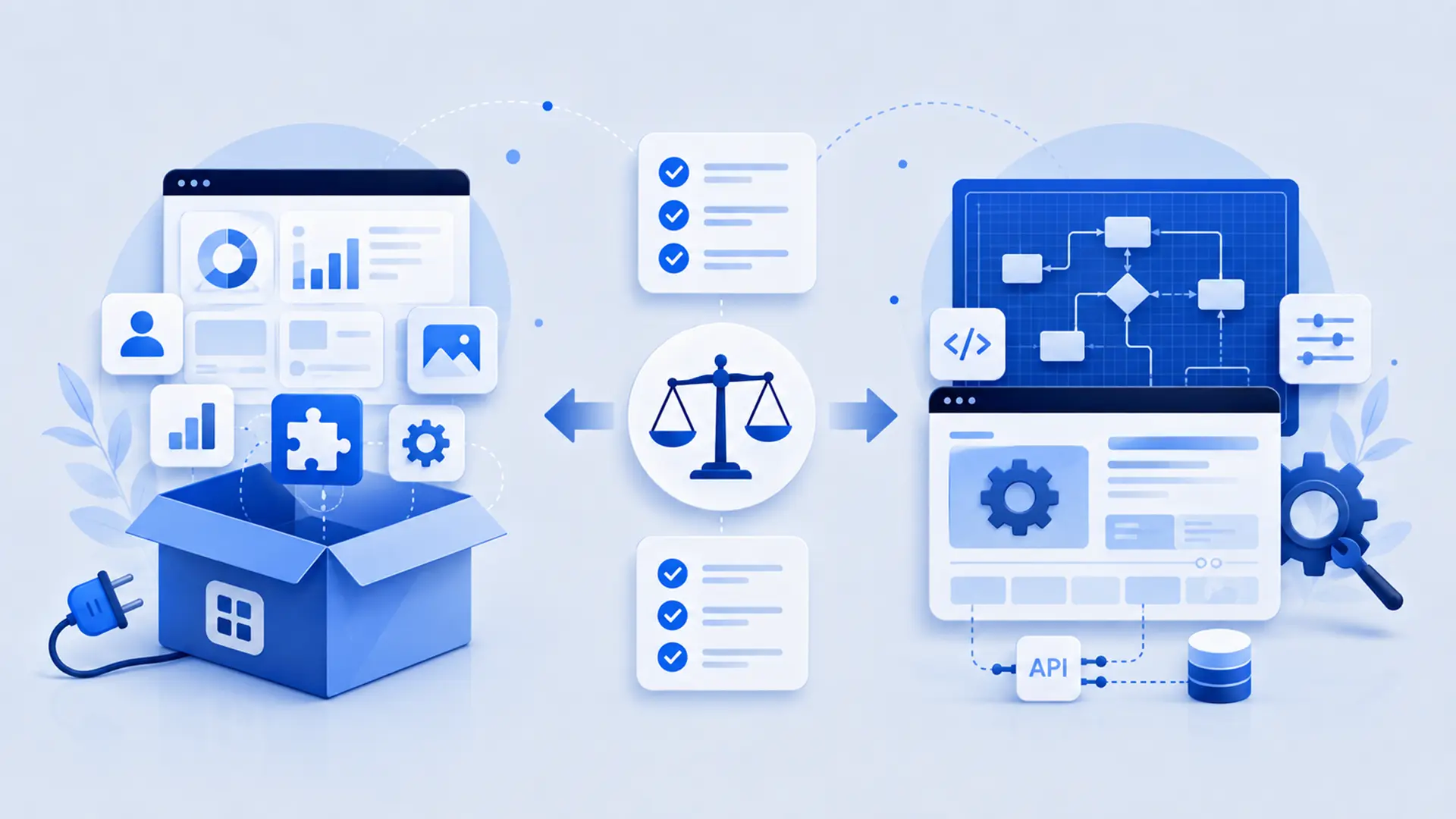
When a business needs new software, it usually faces two options: adopt an off-the-shelf product already available on the market or develop custom software around its own workflows. Both approaches can be the right choice in different situations.
Off-the-shelf software can usually be deployed faster and comes with a more predictable initial cost. Custom software can be shaped around existing operations, integrated with other systems in a more controlled way and designed to handle workflows that standard products do not support.
The decision should therefore not be based only on which option is cheaper or appears more professional. The real evaluation should consider how specific the workflow is, how data must move between existing systems, how much growth is expected and how the software will be managed over the long term.
What Is Off-the-Shelf Software?
Off-the-shelf software is a prebuilt product designed to meet common needs across a defined user base and can be used by many businesses. CRM, accounting, project management, e-commerce, reservation, help desk and human resources systems are common examples.
These systems usually come with a predefined feature set. The business purchases the product or starts a subscription, configures the available options and adapts its operations to the system. In other words, the business typically adjusts to the software to some extent rather than having the software shaped around the business.
A major advantage of off-the-shelf products is that a system that has already been developed and, in many cases, tested by a large user base can be adopted quickly. However, the product’s limits are also defined by its vendor.
What Is Custom Software?
Custom software is developed around the needs of a specific business or product. User roles, data structures, workflows, calculations, integrations and administration interfaces can all be designed around the actual operation.
The goal is not to reproduce every feature available in the market within a single system. It is to focus on the problem the business needs to solve without adding unnecessary components.
For example, if a business needs to connect quotation preparation, customer approval, production planning and delivery, a standard CRM or project management product may cover only part of that process. Custom software can bring those steps together within one workflow.
Webrote’ta custom software development projects as a way to turn real business processes that standard products cannot support into simpler, more manageable systems.
Key Differences Between Off-the-Shelf and Custom Software
| Criteria | Off-the-Shelf Software | Custom Software |
|---|---|---|
| Deployment time | Usually shorter | Requires analysis and development |
| Initial cost | Usually lower | Can be higher depending on scope |
| Flexibility | Limited to what the product supports | Can be designed around the requirement |
| Integration | May be limited by available APIs and extensions | Can be planned around the workflow |
| Control | Greater dependency on the vendor | Greater control over the technical architecture |
| Maintenance | Core product is maintained by the vendor | Maintenance and development must be managed separately |
| Scalability | Depends on product and plan limits | Can evolve with the right architecture |
This table should not be read as proof that custom software is always better or off-the-shelf software is always cheaper. The right choice depends on the level of control and flexibility the business actually needs.
When Does Off-the-Shelf Software Make More Sense?
If the business need is based on a standard process that existing products already handle well, off-the-shelf software is often the better choice. Building every solution from scratch can create unnecessary cost and technical responsibility.
- If the requirement is a common, standardized process in the industry,
- If the software needs to be deployed quickly,
- If the business can adapt to the way the existing product works,
- If custom integration or data-model requirements are limited,
- If the initial budget needs to remain low,
- If the product’s existing capabilities also cover near-term needs, an off-the-shelf solution may be more efficient.
For example, developing a custom project management system for standard task tracking rarely makes sense. If a mature product already meets the requirement, the real value may come from configuring it correctly rather than rebuilding it.
When Should You Choose Custom Software?
The need for custom software usually appears in processes that create competitive advantage or sit at the center of the operation. A particularly strong signal is when standard software starts generating continuous manual work around it.
- If the workflow does not fit standard products,
- If data is constantly transferred manually between multiple systems,
- If critical processes are managed through spreadsheets, email and messaging tools,
- If the team is constantly building workarounds around the existing system,
- If user roles or approval mechanisms are highly specific,
- If the customer-facing service depends directly on the software itself,
- If the current system limits growth or a new business model, custom development should be considered.
The objective is not to create more features. Good custom software should reduce unnecessary steps and make the operation easier to understand and manage.
Building Formulivo from Scratch is a different example of this approach. The requirement was not to customize an existing product, but to build an independent digital product capable of supporting multilingual calculation tools and their integration architecture.
Why Is Looking Only at the Initial Cost Misleading?
One of the most common mistakes when comparing off-the-shelf and custom software is looking only at the initial price. Total cost becomes clear only when the way the system will be used over several years is considered.
An off-the-shelf product may have a low entry cost, but per-user fees, higher-tier plans, additional modules, API access, storage, integrations and transaction volume can change the total cost as usage grows. Custom software may cost more to develop initially, but the underlying infrastructure and maintenance model can often remain under greater business control.
The opposite can also be true. Building a custom system for a standard process used by only a few people may cost far more than paying for an off-the-shelf subscription over many years.
The decision should therefore consider not only license or development fees, but also implementation, data migration, training, integration, maintenance, upgrades and the eventual cost of leaving the system.
How Do Integration Requirements Affect the Decision?
If the software will not operate in isolation, integration capabilities become critical. When data needs to move between CRM and accounting, a website and ERP, an order system and shipping, or a reservation system and payment infrastructure, the product’s API and integration limits need to be reviewed.
With off-the-shelf software, integration is usually limited to the APIs, webhooks and prebuilt connectors provided by the product. If the requirement fits within those limits, that may be sufficient. But when an important process requires repeated CSV exports, copy-and-paste work or manual checks just to move data, the system starts creating operational cost.
Custom software can provide more control here, but integration is still constrained by the technical capabilities of the systems on the other side. It is therefore incorrect to assume that custom development can automatically connect to every system.
How Should Scalability and Future Needs Be Evaluated?
A system that works today should not automatically be expected to work the same way two years from now. As user count, transaction volume, product count, branch count or integration requirements grow, the software’s limitations become more visible.
With off-the-shelf products, growth often means moving to a higher plan or purchasing additional modules. This can be predictable and practical. However, alternatives should be considered if a critical feature exists only in a much more expensive tier or technical limits begin to constrain the business model.
With custom software, it is equally wrong to build every possible future requirement into the first version. Instead, the data model, user roles and core architecture should be designed so new capabilities can be added in a controlled way.
Who Will Be Responsible for Maintenance, Security and Technical Operations?
One important advantage of off-the-shelf software is that maintenance and security updates for the core product are usually handled by the vendor. The business remains more focused on user management, correct configuration, data security and oversight of its integrations.
With custom software, the maintenance model needs to be defined from the beginning. If responsibility for servers, backups, dependencies, security updates, error monitoring and future development is unclear, a project that starts successfully can turn into technical debt within a few years.
Custom software should therefore be treated as a living system rather than a one-time file that is purchased and forgotten. A technical operations plan that keeps the software reliable over time should be part of the project.
Customize an Existing System or Build Software from Scratch?
The decision does not always have to sit at one of two extremes. In many projects, the most efficient approach is to use a reliable existing platform as the foundation and develop only the parts that are specific to the business.
For example, standard user management, content management or payment infrastructure can run on an existing system, while a quotation engine, custom calculations, integrations or an administration panel are developed specifically for the business. This avoids rebuilding solved problems and directs development budget toward requirements that genuinely differentiate the operation.
The limits of customization need to be managed carefully. If dozens of changes begin working against the architecture of the underlying platform, the system can become fragile and difficult to update. At that point, the question is how far the existing system should continue to be pushed.
Questions to Ask Before Making a Decision
- Is the problem we are trying to solve genuinely specific to our business?
- Is there a reliable product on the market that already covers 80-90% of the requirement?
- Is the remaining 10-20% critical to the operation?
- Which systems does the software need to exchange data with?
- How much could user count and transaction volume grow over the next two or three years?
- What will the total licensing and add-on cost of the off-the-shelf product be?
- If custom software is developed, who will manage maintenance and technical operations?
- If the vendor or developer changes, how will continued access to the data and system be handled?
- Is it easier for the business to adapt to the software, or more valuable for the software to adapt to the workflow?
So, Off-the-Shelf or Custom Software?
If the requirement is standard, existing products handle the process well enough and rapid deployment matters, off-the-shelf software is usually the better choice. Building a system from scratch simply because it should be custom can create unnecessary cost and maintenance overhead.
Custom development may make more sense when critical business processes do not fit standard products, manual work keeps increasing, multiple systems need to operate together or the software itself becomes part of the business model.
The strongest approach is not to treat off-the-shelf and custom software as competing ideologies, but to determine which problem can be solved with less complexity and a more sustainable total cost under each model.
If an off-the-shelf system no longer supports an important process in your business, you can explore our Custom Software Development services or tell us about your project so we can evaluate the requirement together.
Leave a Reply